Pura Tirta Empul
Tirta Empul temple is a Hindu Balinese water temple located near the town of Tampaksiring, Bali, Indonesia. The temple compound consists of a petirtaan or bathing structure, famous for its holy spring water, where Balinese Hindus go to for ritual purification. The temple pond has a spring which gives out fresh water regularly, which Balinese Hindus consider to be holy or amritha. Tirta Empul means Holy Spring in Balinese.
Tirta Empul Temple was founded around a large water spring in 962 A.D. during the Warmadewa dynasty (10th-14th centuries). The name of the temple comes from the ground water source named “Tirta Empul”. The spring is the source of the Pakerisan river. The temple is divided into three sections: Jaba Pura (front yard), Jaba Tengah (central yard) and Jeroan (inner yard). Jaba Tengah contains 2 pools with 30 showers which are named accordingly: Pengelukatan, Pebersihan and Sudamala dan Pancuran Cetik (poison).
The temple is dedicated to Vishnu, another Hindu god name for the supreme consciousness Narayana. On a hill overlooking the temple, a modern villa was built for President Sukarno’s visit in 1954. The villa is currently a rest house for important guests.
Kintamani
The area of north-eastern Bali at the Mount Batur caldera, and which encompasses Penelokan, Toya Bungkah, Batur, Kedisan, Abung, Songan and Kintamani villages, is known widely as just Kintamani. Kintamani, Batur and Penelokan villages sit on the rim of the huge Batur caldera about 1,500m above sea level, and offer dramatic views of the active volcano Mount Batur and serene Lake Batur. Toyo Bungkah village is down at the lake edge. As well as the lake and the volcano, Kintamani is home to Pura Ulun Danu Batur, one of Bali’s key nine directional temples.
Tanah Lot
Tanah Lot is one of the important directional temples in Bali. The temple is located on a rock just offshore. It is said to be the work of revered 15th century Hindu priest Nirartha and forms an important element of Balinese spirtualism and mythology.
This is an extremely popular tourist destination and the whole area is often very busy indeed, especially in the late afternoons, pre-sunset. The area between the car park (Rp 5,000 per vehicle) and the beach adjacent to the temple is a maze of souvenir shops selling just about every Balinese trinket imaginable.
Once you have fought your way through the souvenir vendors to the beach, you will see the magnificent temple perched on a rock just a few metres offshore. There is a footpath to the raised cliff area just to the south from where the views of the temple and the sunset behind it are outstanding. Photo-opportunities abound.
At low tide visitors can walk to to the base of Tanah Lot. For a small donation you can be blessed and can then walk some 20 metres around the side on a path, that eventually leads up to the temple. You have no better view of than from that on the sand. The only advantage being that you are standing on the base of Tanah Lot itself.
Pura Ulundanu & Beratan Lake
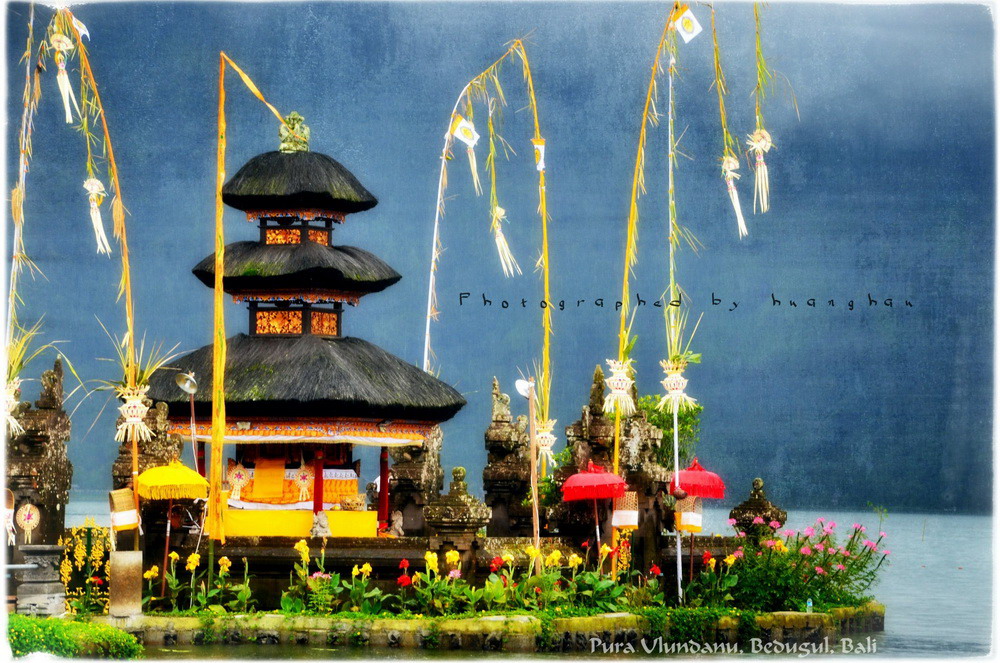
is a major Shivaite and water temple on Bali, Indonesia. The temple complex is located on the shores of Lake Bratan in the mountains near Bedugul. Water temples serve the entire region in the outflow area; downstream there are many smaller water temples that are specific to each irrigation association (subak).
Built in 1663, this temple is used for offerings ceremony to the Balinese water, lake and river goddess Dewi Danu, due to the importance of Lake Bratan as a main source of irrigation in central Bali. The 11 stories of pelinggih meru dedicated for Shiva and his consort Parvathi. Buddha statue also present inside this temple.
Lake Bratan is known as the Lake of Holy Mountain due to the fertility of this area. Located 1200 m above sea level, it has a cold tropical climate.