Kalbarri City, Hamelin Pool, Shell Beach, Eagle Bluff & Monkey Mia Dolphin Resort

Kalbarri City
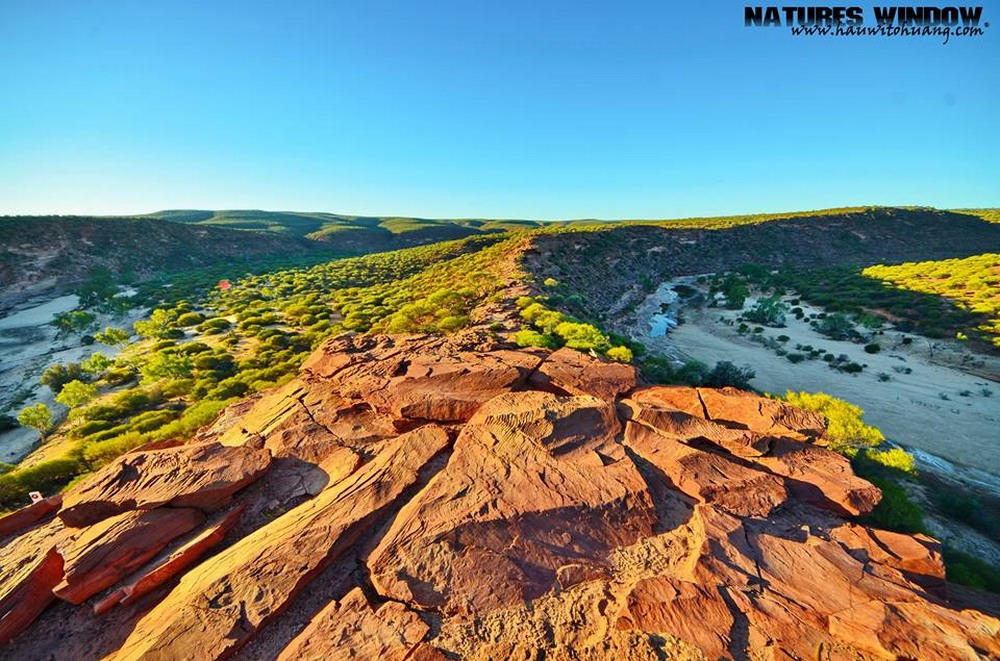
Check out from Kalbarri Palm Resort we are going to Monkey Mia, it’s 401km from Kalbarri city. First we stop over for a while at couple stop point in Kalbarri city for take a photo. Then we continue the drive with next stopover at Hamelin Pool Stromatolites, it’s 280km from Kalbarri city.
Hamelin Pool Stromatolites
Hamelin Pool is home to the most diverse and abundant examples of living stromatolites in the world. Also referred to as ‘living fossils’ these creatures are monuments to life on Earth over 3500 million years ago; a time when no other complex creatures were present on the planet. They are rock-like structures built by microbes (single-celled cyanobacteria) which were the first life forms to appear on Earth. The cyanobacteria trap sediments with mucous to form enormous mats or great reefs of rock-like structures called stromatolites. At first glance these don’t even seem to be living. Each structure is actually a very slow growing microbial colony that may grow less than 1mm per year.
Getting to Hamelin Pool and the stromatolites is easy. Drive the 27km of sealed road from the North West Coastal Highway and turn right at the signs for the last 5km to the Old Telegraph Station. From there it’s a short walk along a formed walking track to reach the boardwalk and view the stromatolites.
Shell Beach
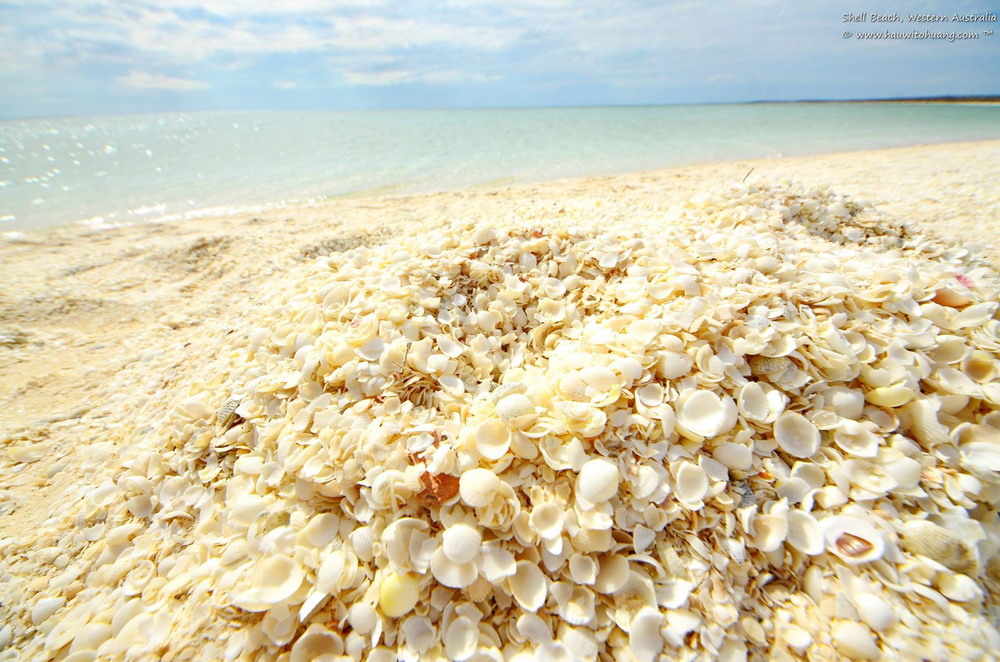
Next stopover is Shell Beach. Shell Beach is a beach in the Shark Bay region of Western Australia, 45 kilometres south-east of Denham.
Situated on the northeastern side of the Taillefer Isthmus, it covers a 110 km long stretch of coast along the L’Haridon Bight. It is one of only two beaches in the world made entirely from shells.
The beach was named “Shell Beach” because of the great abundance of the shells of the cockle species Fragum erugatum. The seawater in the L’Haridon Bight has a high salinity due to both the geomorphology and local climate of the area. This high salinity has allowed the cockle to proliferate unchecked, since its natural predators have not adapted well to this environment.
The shells typically reach a depth of 7 to 10 metres. Over time, the shells have formed a limestone that is known as Coquina. Before Shark Bay became a World Heritage Site, the limestone was mined and used for the construction of a number of buildings in the local town of Denham, Western Australia.
Eagle Bluff
Before arrive at Denham City we stopover a moment at Eagle Bluff.
Eagle Bluff features a spectacularly high cliff that overlooks the Denham Sound near Shark Bay. Walk along the boardwalk to see breathtaking views out across the water.
This site is an excellent spot for divers and snorkelers. If you get a chance to get into the water you will be amazed by the abundance of fish and coral in this stretch of water and if you are lucky you may also see dolphins, sharks and dugongs.
After that we continue drive to Denham. Denham is the westernmost publicly accessible town in Australia, and is named in honour of Captain Henry Mangles Denham of the Royal Navy, who charted Shark Bay in 1858. Today Denham survives as the gateway for the tourists who come to see the dolphins at Monkey Mia, which is located 23 km northeast of the town. The town also has an attractive beach and a jetty popular with those interested in fishing and boating.
Arrive at Denham around 3pm looking for a restaurant, sadly not single one opened. Seems like business in here usually closed from 3pm until 6pm open again. So we continue to Monkey Mia Resort.
Monkey Mia Dolphin Resort
Monkey Mia is a popular tourist destination located about 900 km north of Perth, Western Australia. The reserve is 25 km northeast of the town of Denham in the Shark Bay Marine Park and World Heritage Site.
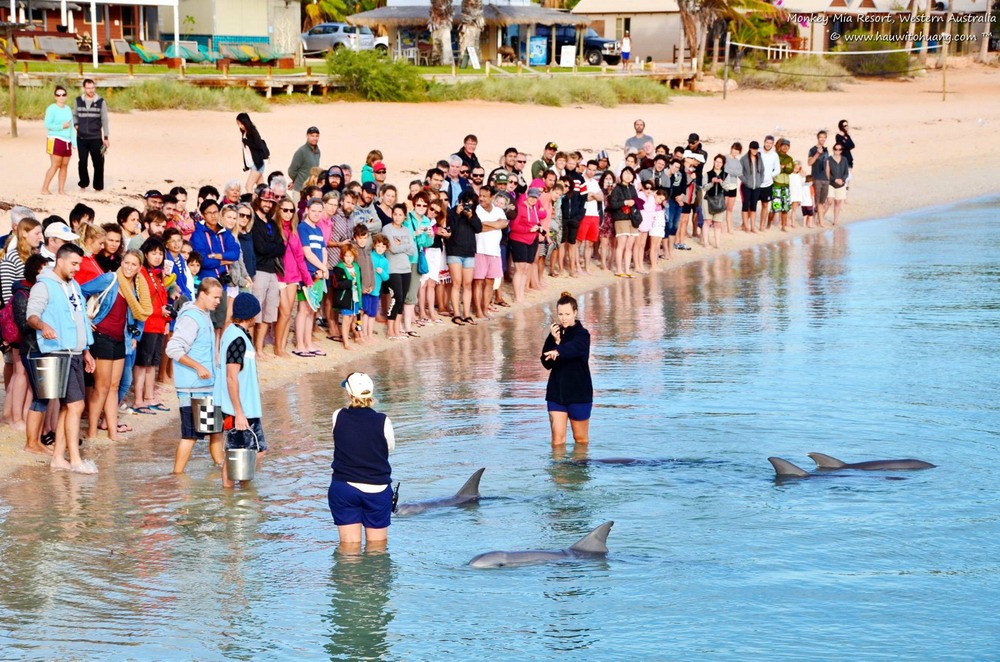
The main attraction are the bottlenose dolphins that have been coming close to shore for more than fifty years. Rangers from the Department of Parks and Wildlife (Western Australia) carefully supervise the Monkey Mia Dolphin Experience.
The area was originally gazetted in 1890 and used as a base for the pearling and fishing industries. In the 1960s, a fisherman and his wife began feeding Bottlenose Dolphins when returning with their catch. As news of the dolphins coming inshore spread, visitors started to come to see them. In 1985, an information centre was built, and in 1988, a special state government grant was provided to develop roads, carparks, and facilities.
In November 1990, the waters adjoining Monkey Mia were declared a Marine Park and are managed by the Department of Parks and Wildlife.
Arrive in monkey mia we pay entrance fee 10aud per person, even for resort guest. After that check in with reception and then straight directly to Boughed Restaurant, the only one in the area. Unfortunately it’s still not open yet.
So we stroll around and hanging at the beach until restaurant opening time which is 6:00pm.
We are the first couple guest in resturant when it open. Me was ordering Chicken Scalopinni, while Mel ordering Fish, total for 64aud.
After finish eat up we going back to our unit and have a rest.
Trip Map